 (Just
inside the time tunnel)
(Just
inside the time tunnel)Dutch T(h)reat
Chapter 3
I found myself in a dim-lit narrow hallway with a ceiling of intersecting Moorish
domes of yellow brick and white stone trimmed with green. The walls were brick,
the floor was stone inlaid with geometric mosaics. It was all straight out of
the Arabian Nights, and, if Ali Baba had popped out of a jar of olive oil and
stolen my watch, I wouldn’t have been the least bit surprised.
Behind me, the lady with the bicycle coughed meaningfully, and I excuse-me’d
and stepped aside to let her pass. At the far end of the hall, maybe 30 feet
from where I stood, she went down six stone steps and through a second doorway,
wheeling her bike down a grooved wooden ramp which had obviously been set there
for that purpose. I trooped along after her, down the steps and through the
inner doorway and into the 17th century.
The street noise, the traffic, the rumble of the trams, the crowds – all
gone. I was in a broad and peaceful courtyard, and I swear it was like that
narrow hallway had carried me three centuries into the past. The old lady was
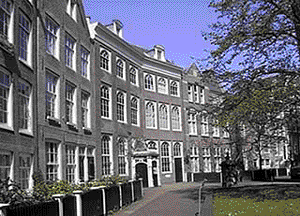
pushing her bicycle along a dusty brick path lined with a dozen lovely two-
and three- and four-story brick houses on the left, and open on the right for
about 50 yards, at which point it curved right and lost itself behind a pretty
country church with a tall brick bell tower capped with slate.
(Just
inside the time tunnel)
Dazed by the unexpected quiet, I started down the path. There was a bulky metal
sculpture of a nun or something on my right, and up ahead I could see the dame
with the bicycle turning in at a gate in the green picket fence which separated
the tiny front yards of the houses from the path, and another old lady peered
down at me suspiciously from the second-floor window of the second house on
my left, but otherwise I seemed to have the entire place to myself.
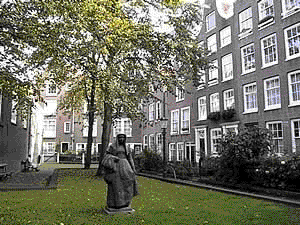 (A
Begijn watching over the Begijnhof)
(A
Begijn watching over the Begijnhof)
Past the church, I could see that the path looped around a kite-shaped plot
of grass, past more houses and the long blank north wall of the church and back
to join up with itself again. In the center of the loop, the grassy area was
raised slightly above ground level and set off by a low brick wall; the grass
was sprinkled with clusters of white and purple narcissus and shaded by five
tall chestnut trees.
 (The bleaching green, looking back at the church.)
So this, then, was the Begijnhof, this oasis of calm in the heart of
the frantic city. This was where I’d be spending my working hours for the
next couple weeks.
Not bad, m’lad!
I’d only planned on looking in for a minute and saying a quick hello, but,
now that I was here, I couldn’t think of any particular reason for leaving.
It was such a relaxing spot, such an idyllic place to be. Even the weather was
cooperating: the clouds had lifted, and the sun was out at last. With what I’m
sure must have been a sappy sort of grin on my face, I strolled around the perimeter
of the central green, soaking up the atmosphere and the fresh scent of the summer
flowers.
The houses were beautiful, each with its little garden and its gauzy white curtains
behind white-trimmed windows. Most of them had their doors on the ground floor,
but a couple had stone stairways with dark green railings leading up a flight
to the main entrance, with a plainer door set into the side of the steps below.
Bottom door for servants, I guessed, and top door for the family and its guests.
Pretty fancy.
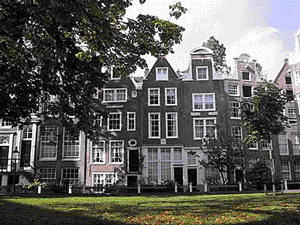 (Are
these places gorgeous, or what?)
(Are
these places gorgeous, or what?)
One of the houses wore an inscription carved into a thick granite lintel between
its second- and third-floor windows: INIVRIA VLCISENDA OBLIVIONE. Latin,
I conjectured, which was all Greek to me. Nearby, another house was dated: Anno
1660.
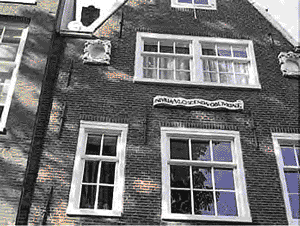 ("Inivria Vlcisenda Oblivione")
There was bird song in the air, and an occasional squawking and flap of wings.
Pigeons waddled around with their beaks to the pathway, searching for lunch.
If I listened carefully, I could just make out the passing of trams in the distance,
but, except for that, it might as well have been anno 1660.
Back in front of the church after my circuit of the green, I looked the joint
over more closely – and discovered to my surprise that the ornate letters
etched into the stone above its wooden double doors read English Reformed
Church, Anno 1607.
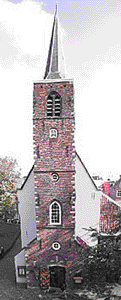 (Bird's-eye
view of the English Reformed Church.)
(Bird's-eye
view of the English Reformed Church.)
Even in here, even the church was in English!
A bronze plaque to the left of the doors confirmed it: "This church
is believed to have been built in 1392," it said, in English capitals.
"In 1607 it was given to English-speaking Presbyterians living in Amsterdam.
It was enlarged in 1665. An extensive restoration was completed in 1975. An
international Christian community continues to worship here."
I tried the doors, and they were unlock-Ed. There was a wood-panelled vestibule,
and then the church proper, one large white room with an arched ceiling and
blue support beams. The walls, incongruously, were lined with flags; I recognized
the Stars and Stripes, the Maple Leaf, and the Union Jack, but there were half
a dozen others I didn't know. Above the altar and beneath a stained-glass window
showing a group of Pilgrims praying around the mainmast of a ship at sea was
painted, in English, the legend, "Create in me a clean heart, O God."
There were 20 rows of plain wooden pews flanking an aisle that stretched from
where I stood up to the altar, and a man in a lightweight gray suit with a turned-around
collar was sidling up and down the narrow spaces between the rows gathering
prayerbooks. Sunday services must have let out not long ago.
I’m not usually much of a Boy Scout, so I guess it was the general tranquility
of the place that inspired me to do my good deed for the day. The minister was
working the right side of the center aisle, so I took the left side and pitched
in.
He noticed me, then, and flashed me a gracious smile. "That’s very
kind of you," he called across the wide room.
"My pleasure."
We met up back by the vestibule door, where there was a wooden rack for the
prayerbooks. A thicket of organ pipes gleamed proudly from its perch above the
doorway.
"The Reverend William Llewellyn Jones, L.L.B., B.D., M.A.," he introduced
himself, wiping his right hand on his trousers and holding it out to me, "although
most everyone in my ‘flock,’ such as it is, calls me Reverend Bill."
We shook hands. "I’m John Lewis Farmer," I said, "B.A. and
trying to finish my M.A., ASAP. And, back where I come from, most everyone calls
me Jack."
"You’re from America, then?" Reverend Bill’s accent was
veddy veddy British. He was in his late 30s, I’d venture, a little shorter
than my own 6’2", but thin where I’m, well, not thin and
light-complected where I’m practically Mediterranean. He had clear brown
eyes under fine eyebrows and a shock of sandy hair, a straight nose and a pleasant
smile and a small black mole to the side of a weakish chin.
"Sure am," I admitted. "Battle Creek, Michigan, home of Kellogg’s
Corn Flakes and not a whole heck of a lot else. You're English, right?"
He wagged a chiding finger at me. "Welsh, if you please. There is
a difference, you know, though not many of you Colonials seem to be aware of
it. Is this your first visit to the Begijnhof?"
"Yeah, it is, actually. My first day in Amsterdam, too. First day in Europe,
when you get right down to it."
"Your very first day on the Continent, and here you are!" He clapped
his thin hands together at chest level and held them that way, beaming all over
his pale face as if he’d just been elected Pope, or whatever it is Presbyterians
get elected. "My, my. My, my, my! This is an honor. Are you
on summer holidays, then? Just doing Holland, or is this one of those 11-countries-in-eight-weeks
Grand Tours you Americans seem to enjoy so much? If it’s Sunday, this must
be Amsterdam, that sort of thing?"
Anyone else and I’d probably have been offended, but Reverend Bill managed
to come across as truly friendly, truly interested.
So I told him what I was here for, and he immediately took me by the elbow and
steered me back out through the vestibule to the double doors. "If you're
here for two weeks," he said, "we’ll have buckets of time to
chat, but right now I suggest you pop over to the Wooden House and make the
acquaintance of Gerrit Rombach. He was here for our little service just now,
so I’m quite sure you’ll find him in. He’s in charge of the archives,
you know, and I expect he’ll be delighted to meet you."
Gerrit Rombach, that was the man Professor Harriman had told me to see. I didn’t
much feel like bugging him on a Sunday, but with Reverend Bill so pleased to
be able to bring us together I figured I’d at least drop by for a second
and let him know I’d arrived.
So I promised the good Rev I’d look him up for a cuppa and ambled back
toward the Wooden House. It was the only wooden structure in the Begijnhof
– everything else was brick – and the first building I’d passed
on my way in, right across from the statue of the nun that’d been one of
the first things I’d noticed after emerging from the time tunnel.
What I noticed now was not the metal sculpture, but the flesh-and-blond female
heading for the entrance of the place next door to the Wooden House, where the
same old lady I’d spotted earlier was still at her post in the second-floor
window, looking out at the scene below as if she didn’t quite trust it.
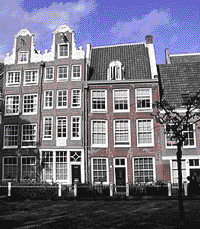 (Mevrouw
Moen and Jet's house. Who are they? Keep reading!)
(Mevrouw
Moen and Jet's house. Who are they? Keep reading!)
The girl I had my eye on was no old lady. Far from it. She was my age, give
or take, and about as pretty as a human being can get without the help of an
airbrush. She had a soft oval face that didn’t need makeup and wasn’t
wearing any, and sapphire eyes so blue I could feel their color from 20 feet
away. Her long silken hair was tied back in a ponytail, and she wore a turquoise
scarf salted with silver spangles around her neck and faded jeans over a black
leotard which displayed curves that made my fingers tingle.
She saw me looking at her, and I guess she must have read
mah mind, because I swear to God I saw her cheeks pinken as she passed through
the green picket gateway of number 33 and let herself into the house. She turned
around in the doorway and raised a hand and waved at me. Then, smiling, she
closed the door behind her.
One flight up, the sainted old soul in the window was glaring at me with what
I believe is called a moue of distaste. Actually, make that about a moue and
a half. She must have been tuned in to the Farmer brainwaves, too, and I could
see she didn’t much care for the way I’d been eyeballing her granddaughter.
I raised a hand and waved at her, and went next door to the Wooden House whistling
"Dixie."
It was really an attractive building, four stories high with the ground floor
dressed in white stone behind a shallow garden crowded with two massive rhododendron
bushes, and, upstairs, weathered boards stained black and dotted with double
tiers of white-framed windows at the second and third floors – I’m
talking American, here, if it’s all the same to you – and a simple
triangular gable. Just above the deep-green front door, the words "het
houten huys"
were painted in black Olde English letters, with the three initial lower-case
haitches highlighted in red.
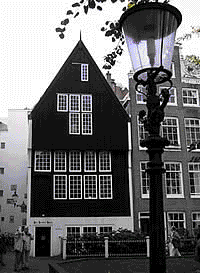 (het houten huys)
I knocked on the door and heard someone bustling around inside. A minute later,
it swung open to reveal a middle-aged Munchkin in the doorway. He was a burly
gentleman, though short, with deep-set black eyes and graying hair combed across
the top of his head in a futile attempt to make it look like he wasn’t
a candidate for Minoxidil therapy. He was biting his lower lip as he stood there,
and it was plain that he was upset about something. "It’s Sunday,"
he said, in English. I felt like I was wearing a sandwich board with "American
Tourist!" on it in screaming Day-Glo capitals. "I’m closed today.
You’ll have to come back another time."
"Mr. Rombach?" He’d been about to shut the door in my face, but
he hesitated at the sound of his name. "I’m Jack Farmer, sir. Professor
Harriman sent me? From the University of Michigan?"
His troubled face lit up. "Mr. Farmer! Mr. Farmer!" he cried, swinging
the door wide and squeezing my hand like he was trying to get water out of it.
"Je komt als geroepen, jongen! Come in!"
Return to Table of Contents.
Return to Writing
Return to Home